

Last Updated: November 26, 2026
Quick Summary
To absorb collagen from supplements, choose hydrolysed collagen peptides, which are already broken into short chains your body can take up, and take them consistently every day. Pair them with a formula that supports digestion, and get vitamin C from your diet to support your body's own collagen production.
- Whole collagen cannot cross the gut wall intact; enzymes must first break it into peptides and amino acids.
- A 2022 review reports orally consumed collagen peptides are absorbed relatively quickly, linked to their lower molecular weights.
- Take collagen powder daily at whatever time you will remember it; no window of the day outperforms another.
- Hot drinks are fine for hydrolysed collagen, but stir the powder into a little cold liquid first to stop clumping.
- Give any collagen routine at least eight to twelve weeks before judging results.
Table of Contents
- What is the best way to absorb collagen from supplements?
- Why whole collagen cannot be absorbed as it is
- What happens to collagen after you digest it
- How to take collagen powder for better absorption
- Collagen absorption and vitamin C: what the evidence says
- The best time to take collagen supplements
- Collagen powder in hot drinks: does heat break it down?
- Ingredients that support absorption in an all-in-one blend
- When to expect results and what to check first
- Frequently Asked Questions
What is the best way to absorb collagen from supplements?
The best way to absorb collagen from supplements is to choose hydrolysed collagen peptides, take them consistently each day, and pair them with a formula that supports digestion. Collagen in its whole form cannot be absorbed; it must first be broken down into peptides, as Harvard Health Publishing explains in its overview of collagen digestion.
Most collagen advice focuses on the powder itself. The real story is what your gut does with it.
Here is what most guides get wrong: absorption is not something you can force with a trick. It is a process your body runs on its own. Your job is to give it the right raw material, in the right form, at the right dose.
Below, we explain exactly how to absorb collagen well, from label reading to timing to what you mix it with.
Why whole collagen cannot be absorbed as it is
Whole collagen is a large, tough protein. Your body cannot pull it through the gut wall intact. It has to break it down first.
Enzymes in your stomach and small intestine cut the protein into smaller pieces called peptides and amino acids. Only these smaller fragments pass into the bloodstream. This is why the form of collagen in your supplement matters more than almost anything else.
Hydrolysed collagen has already been partially broken down. The process, called hydrolysis, produces short peptide chains that are easier for the body to handle. A 2022 review of collagen supplements reports that orally consumed collagen peptides are absorbed relatively quickly, linking this to their lower molecular weights. For more detail on why the hydrolysed form absorbs better, read Hydrolysed Collagen Protein.
Watch out: buying unhydrolysed collagen powder and expecting fast absorption is a common and expensive mistake.
What happens to collagen after you digest it
Most guides stop at "the peptides are absorbed". That is only half the story, and the half that matters least for whether you see a result. The more honest question is: once the peptides are in your bloodstream, what actually happens to them?
Here is the short version of the journey:
- Collagen enters the stomach and meets digestive enzymes
- Enzymes break the protein into peptides and amino acids
- Peptides cross the gut wall into the bloodstream
- The body distributes them around the body, but not necessarily to where you want them
- Some fragments act as signals that prompt your own collagen-producing cells
That fourth point is where the marketing gets ahead of the science. Absorbing a peptide does not mean your body sends it to your skin, your joints or your ligaments.
Absorption alone does not guarantee a visible benefit. Harvard Health Publishing notes that oral collagen supplements are believed to be more effectively absorbed in their hydrolysed form, but that this does not establish a guaranteed outcome.
The practical implication is reassuring rather than discouraging. You do not need to "target" your collagen or time it around a workout to send it to a particular joint.
How to take collagen powder for better absorption
Take collagen powder daily, mixed into a drink you will actually finish, and keep the habit consistent. Consistency does more for absorption than any timing trick.
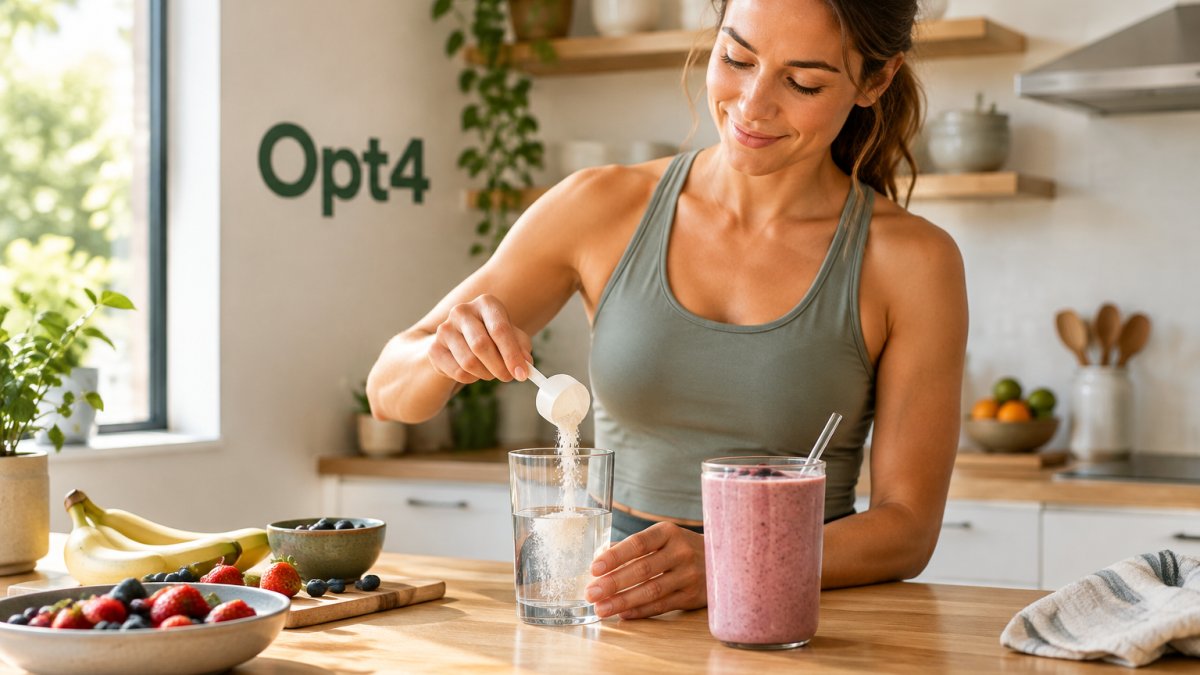
A few practical rules help:
- Mix the powder fully so no clumps sit at the bottom of the glass
- Use a drink you enjoy, because you are more likely to keep it up
- Take it at the same time each day to build the habit
- Keep the scoop dry and sealed between uses
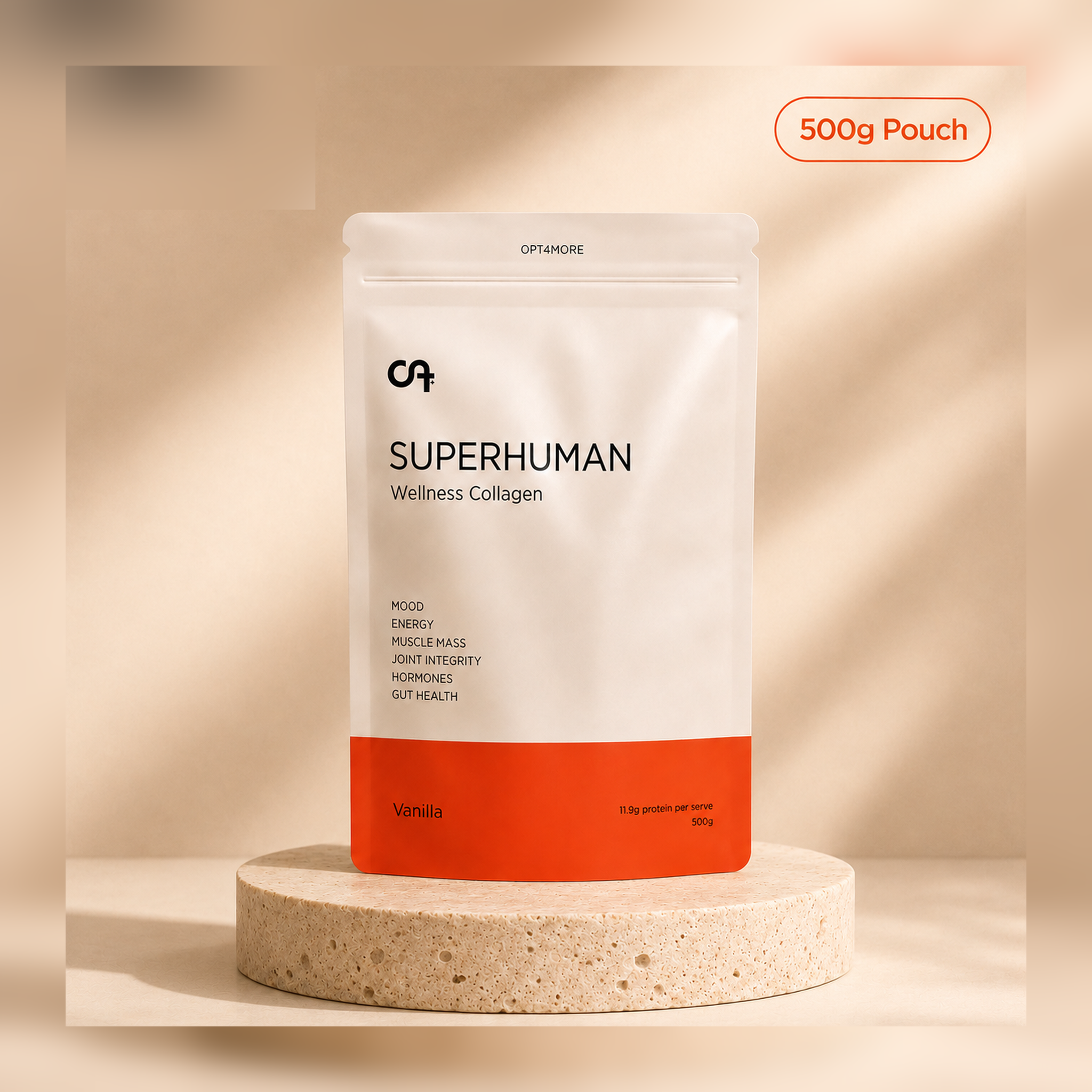
The powder is easy to add to water, smoothies, coffee or a breakfast bowl. If you want to put the advice into practice, the Superhuman Wellness Collagen Blend - 500g Pouch lists the form and serving size on the pack.
Reading the label: dose, form and serving size
Check three things before you buy: the collagen form, the amount per serve, and how many serves the pack holds. Hydrolysed collagen peptides should be named clearly. The dose per serve should be stated in milligrams or grams, not hidden behind a blend.
Opt4SUPERHUMAN's Superhuman blend discloses 12,895 mg of hydrolysed bovine collagen peptides per 20 g serve, plus 11.9 g of protein. That level of disclosure is what you should look for on any label. For a full checklist, see 7 Things to Check When Choosing a Collagen Supplement for Women.
Collagen absorption and vitamin C: what the evidence says
Vitamin C and collagen are linked in the body's own production of collagen. Understanding that link is useful before spending money on an "absorption booster".
There are two separate questions here, and they get blurred together constantly:
- Does vitamin C help you build collagen? This is about synthesis, and here the answer is yes. Vitamin C is a required cofactor for the enzymes that stabilise newly formed collagen. Without enough vitamin C, your body cannot assemble collagen properly, regardless of how much peptide you absorb.
So vitamin C supports the use of collagen, not the uptake of it. That is a meaningful difference, and it is where a lot of marketing gets loose with the facts.
A commonly cited study, summarised by the Beckman Laser Institute at the University of California, Irvine, described increased ligament collagen synthesis after participants consumed vitamin-C-enriched collagen and completed six minutes of jump roping. The available summary does not state the sample size, the collagen dose or the publication year, so treat it as a promising signal rather than a settled rule. It also does not show that vitamin C improved absorption, it points to synthesis, in a specific exercise context.
The practical takeaway is simple. A varied diet supports collagen formation, while recovery after an injury can raise different questions, making a guide on collagen for recovery a useful next step.
Watch out: products marketed as "collagen with absorption-enhancing vitamin C" are usually just collagen plus a nutrient your body needs for synthesis anyway. That is not dishonest, but it is not the absorption shortcut the label implies.
The best time to take collagen supplements
The best time to take collagen is whenever you will remember it. There is no strong evidence that one window of the day outperforms another for absorption.
What the research does support is consistency. Daily intake gives your body a steady supply of peptides rather than an occasional large dose.
Empty stomach or with food?
Either works. Some people prefer an empty stomach first thing in the morning. Others find it sits better with food.
- Empty stomach: quick and easy, good for a morning habit
- With food: gentler if powder on an empty stomach bothers you
- With a meal containing protein: may feel more like part of a normal routine
Pick one and stick with it. The habit beats the timing.
Collagen powder in hot drinks: does heat break it down?
Hot drinks are fine for hydrolysed collagen. The peptides are already broken down, so a warm coffee or tea will not undo that work. Very high heat over a long time can affect texture, but a normal hot drink is not a problem.
Stir the powder into a little cold liquid first, then add the hot drink. This stops clumping and keeps the texture smooth. For ideas, browse Recipes + Ways to Use SUPERHUMAN, which covers coffee, smoothies and breakfast bowls.
Ingredients that support absorption in an all-in-one blend
Digestive enzymes are the ingredients most directly tied to absorption. Amylase, protease, lactase, lipase and cellulase help break down carbohydrates, protein, lactose, fats and plant fibre respectively. Protease is the one that acts on protein, including collagen.
The Opt4SUPERHUMAN formula also includes Weizmannia coagulans MTCC 5856 at 3 billion CFU, a named probiotic strain, plus 2,000 mg of green banana resistant starch, a prebiotic fibre. The individual amounts of the enzymes are not disclosed on the information available, so no dose match should be assumed.
An all-in-one blend saves you from stacking separate tubs. A separate-product basket across these categories costs about $290 upfront, compared with $79 for one Superhuman pouch, or $72 on subscription. That is an approximate upfront checkout comparison, not a dose-for-dose saving. To compare ingredient lists properly, read How to Compare Collagen Blend Ingredients and Serving Size.
| Approach | What you get | Practical trade-off |
|---|---|---|
| Single-ingredient collagen | One collagen dose per serve | Simple, but no digestive or nutrient support |
| Separate product stack | Each ingredient bought on its own | Broad, but about $290 upfront and many tubs |
| All-in-one blend | Collagen plus enzymes, probiotic, fibre and minerals in one scoop | One daily serve, $79 per pouch or $72 on subscription |
Upfront cost of collagen approaches
When to expect results and what to check first
Give any collagen routine at least eight to twelve weeks before judging it. Skin, joint and connective tissue changes build slowly, and the research base looks at outcomes over weeks and months, not days.
A 2026 umbrella review in PMC reports consistent, clinically meaningful benefits for skin, bone and muscle health across the studies it examined. That is encouraging, but it describes collagen supplementation broadly, not any single product.
Before you blame the powder, check these basics:
- Are you taking it every day without gaps?
- Is the dose on the label actually being met?
- Are you eating enough protein and vitamin C overall?
- Are you sleeping and moving enough to support recovery?
If you take medication, have a health condition, or are pregnant or breastfeeding, speak with a health care professional before starting a new supplement.
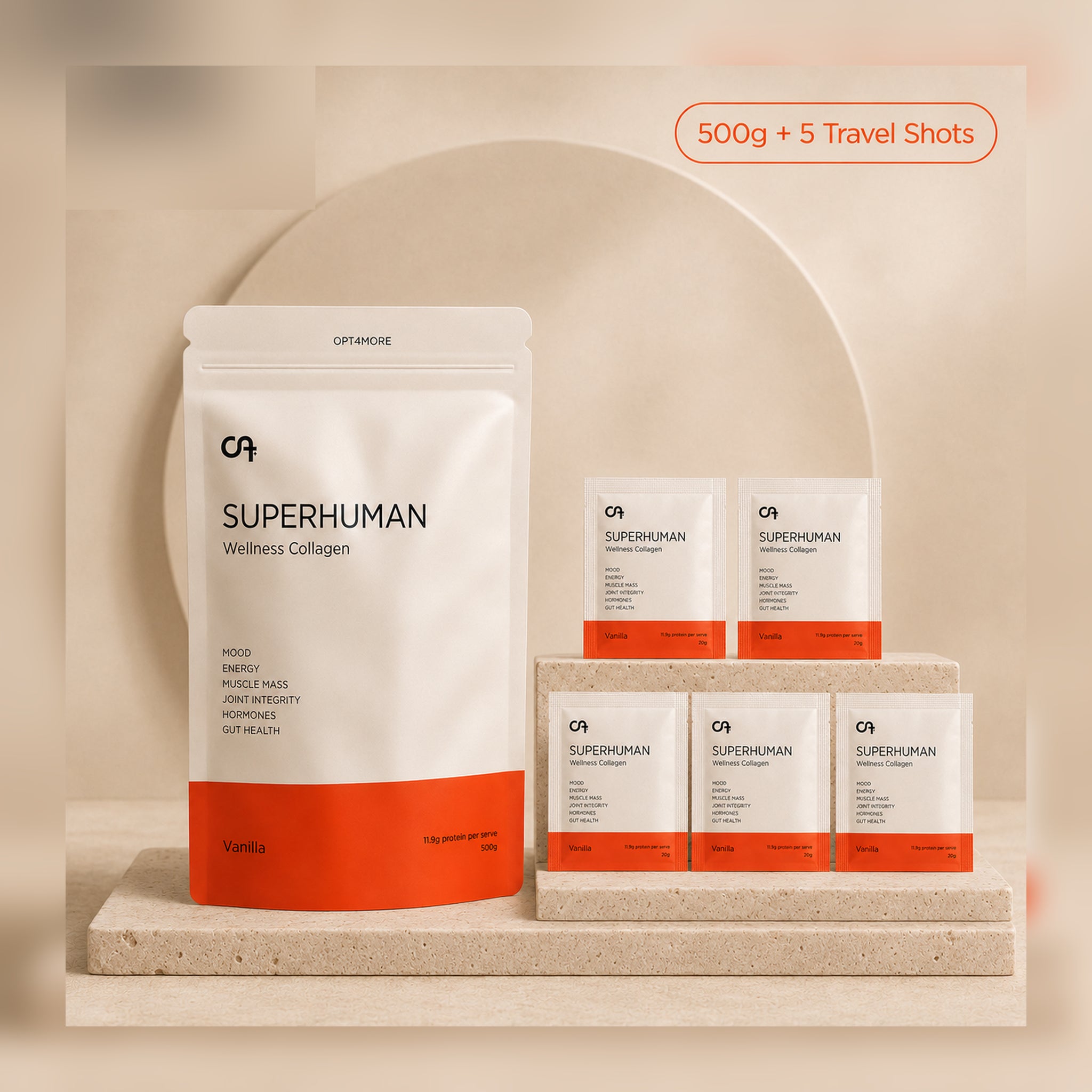
Getting collagen absorption right comes down to form, dose and consistency, not clever hacks. Opt4SUPERHUMAN makes that routine simpler with the Superhuman Wellness Collagen Blend, an all-in-one daily scoop with 12,895 mg of hydrolysed bovine collagen peptides, digestive enzymes, the named probiotic strain Weizmannia coagulans MTCC 5856 and a quinoa-sprout B-complex.
Frequently Asked Questions
Does vitamin C help your body absorb collagen?
Vitamin C is a cofactor in collagen synthesis, the process your body uses to build its own collagen, rather than a direct aid to absorbing collagen peptides from a supplement. Pairing a collagen supplement with vitamin-C-rich foods such as citrus, capsicum or berries is a sensible everyday habit, but it does not guarantee a particular outcome.
Should you take collagen on an empty stomach?
There is no strong evidence that an empty stomach improves how well you absorb collagen. Most people tolerate a serve mixed into water or a smoothie at any time of day. The bigger factor is consistency: taking it at the same time daily, such as with breakfast or after training, makes the routine easier to keep. If you experience digestive discomfort, take it with food.
Can you mix collagen powder into hot drinks?
Yes. Hydrolysed collagen peptides are already broken into small peptides, so stirring a serve into coffee, tea or warm water does not undo that. Avoid boiling liquid and add the powder once the drink has cooled slightly, then stir well to prevent clumping. A 20 g serve of Superhuman Wellness Collagen Blend dissolves easily in warm drinks, and the same serve can go into cold water, juice or a smoothie if you prefer.
How long does it take for collagen supplements to work?
Timelines vary and no supplement is guaranteed to produce a specific result. Give a daily routine several weeks of consistent use before judging it, and speak with a health care professional if you have a medical condition or take medication.
