

Last Updated: November 22, 2026
Quick Summary
Collagen peptides may support joint pain, joint function and pain-free exertion, with a 2021 systematic review reporting benefits across all five included studies. They supply glycine, proline and hydroxyproline that joint tissue relies on, but they are not a repair kit for worn cartilage. Research is still evolving and findings are often conflicting.
- A 2021 systematic review found all five included studies reported joint pain, function or pain-free exertion benefits.
- A 2025 review of type I collagen hydrolysate reported increased physical mobility across the studies examined.
- The research does not demonstrate cartilage regrowth or measurable cartilage thickening in humans taking collagen peptides.
- A 20 g serve of the Superhuman blend provides 12,895 mg of hydrolysed bovine collagen peptides and 11.9 g of protein.
- No review in the supplied data specifies a timeframe, so commit to eight to twelve weeks of consistent daily use.
Table of Contents
- Why Collagen Peptides Matter for Joint Health
- Benefit 1: Collagen Peptides for Joint Pain and Everyday Comfort
- Benefit 2: Better Joint Function and Mobility
- Benefit 3: Support for Cartilage and Connective Tissue
- Benefit 4: Faster Recovery After Strenuous Exercise
- Benefit 5: Everyday Bone and Muscle Support
- Collagen Peptides Dosage for Joints: What the Research Suggests
- How Long Does Collagen Take to Work for Joints?
- Frequently Asked Questions
Why Collagen Peptides Matter for Joint Health
Collagen peptides are short chains of amino acids produced when collagen is broken down through hydrolysis, and they matter for joint health because they supply the glycine, proline and hydroxyproline that joint tissue relies on. A 2021 systematic review found all five included studies reported benefits for joint pain, joint function or pain-free exertion (Khatri et al. systematic review on collagen peptide supplementation).
Collagen peptides may support comfort and function, but they are not a repair kit for worn cartilage. The Cleveland Clinic notes that research on collagen peptides is still evolving and findings are often conflicting (Cleveland Clinic overview of collagen). Below are five benefits, ranked by how well the evidence holds up.
Benefit 1: Collagen Peptides for Joint Pain and Everyday Comfort
Collagen peptides for joint pain rank first because this is where the research is most consistent, but "most consistent" is not the same as "settled". The 2021 systematic review by Khatri and colleagues reported benefits for joint pain, joint function or pain-free exertion in all five included studies (Khatri et al. systematic review on collagen peptide supplementation). That is a promising signal, not proof, and the review itself is small.
What most guides skip is the difference between three things readers tend to blur together:
- Activity-related soreness, the ache after a long walk, a gym session or a weekend of gardening. This is the outcome most collagen peptide studies actually measure, often through pain scores during or after exercise.
- Ongoing joint pain, persistent discomfort that is present at rest or first thing in the morning. This is a different clinical picture and is not what the peptide literature is primarily designed to assess.
- Pain-free exertion, the ability to complete a movement (climbing stairs, standing from a chair, walking a set distance) without pain. The 2021 review counted this among its positive findings, and it is arguably the most practical outcome for everyday life.
Hydrolysed collagen is absorbed as short bioactive peptides rather than intact protein, which is why it is studied for everyday comfort rather than as a painkiller. The mechanism proposed in the literature is that these peptides may act as signalling molecules that support the cells responsible for maintaining joint tissue, not that they numb pain directly.
Studies vary widely in collagen type, dose, duration and the population recruited. That variation is why the same review can be described as "promising" by one commentator and "inconclusive" by another without either being wrong.
Anyone with persistent joint pain, swelling, stiffness that lasts more than about 30 minutes in the morning, or pain that limits daily activity should see a health care professional rather than self-manage with a supplement. Collagen peptides are an everyday wellness input, not a treatment.

Benefit 2: Better Joint Function and Mobility
Better joint function and mobility is the second benefit, and it shows up in the research as improved knee and ankle function rather than raw pain scores. The 2021 review noted improvements in ankle or knee function among its positive findings. A 2025 systematic review of type I collagen hydrolysate reported increased physical mobility across the studies it examined (Brueckheimer et al. review of type I collagen hydrolysate).
In practice, this means stairs, gardening and getting off the floor feel less like a negotiation. The evidence does not promise structural change in the joint itself.
Benefit 3: Support for Cartilage and Connective Tissue
Support for cartilage and connective tissue is plausible but the least directly proven of the five benefits.
What cartilage actually is. Joint cartilage is a specialised tissue made largely of type II collagen fibres woven around proteoglycans, which hold water and give cartilage its cushioning. Chondrocytes are the cells embedded within that matrix, and they are responsible for maintaining it, building new collagen and proteoglycans while breaking down worn material. Cartilage is avascular, meaning it has no direct blood supply, which is part of why it heals slowly compared with muscle or skin.
What collagen peptides can and cannot do. Collagen peptides supply glycine, proline and hydroxyproline, the same amino acids cartilage is built from, and the body can use them as raw material. Some research also suggests peptide fragments may act as signals that support chondrocyte activity. The supplied research does not demonstrate cartilage regrowth or measurable thickening of cartilage in humans taking collagen peptides. The honest framing is tissue support, not tissue repair. Because tissue support is not the same as cartilage repair, pairing realistic expectations about collagen peptides with practical movement habits can help keep joint care grounded, as BURTON HealthLabs notes.
Why collagen type matters here. Type II collagen is the dominant form in cartilage, while type I dominates in tendon, ligament and bone. Hydrolysed collagen peptides, the form in the Superhuman blend, are broken down into short peptides regardless of their original type, so the body reassembles what it needs rather than delivering "cartilage collagen" directly to cartilage. Readers comparing products should check which form is on the label rather than assuming all collagen is the same.
Connective tissue beyond cartilage. Tendons and ligaments are also collagen-rich, and this is where the peptide research is somewhat more developed, particularly around exercise recovery, which is covered under Benefit 4. The practical takeaway is that collagen peptides are one input among several for connective tissue: resistance and load-bearing exercise provide the mechanical signal that tells the body to maintain tissue, and adequate total protein supplies the broader amino acid pool. Collagen is not a substitute for either.
Readers wanting the fuller picture on collagen types can read the comparison of collagen types for skin and joints.
Benefit 4: Faster Recovery After Strenuous Exercise
Faster recovery after strenuous exercise has partial support. The 2021 systematic review included faster recovery and improved pain-free strenuous exertion among its reported benefits. That is a meaningful outcome for gym-goers and runners, though it reflects study-level findings rather than a guaranteed personal result.
The practical takeaway: consistency beats timing tricks. A daily serve taken alongside normal protein intake is the approach studied, not a single large dose before training.
Benefit 5: Everyday Bone and Muscle Support
Everyday bone and muscle support rounds out the list, and it is where collagen overlaps with protein. A 20 g serve of the Superhuman blend provides 12,895 mg of hydrolysed bovine collagen peptides and 11.9 g of protein, which contributes to daily protein intake for muscle maintenance.
Collagen is not a substitute for resistance training or adequate total protein. It is one input among several, and the formula's calcium, magnesium, zinc and vitamin D3 contribute to normal bone and muscle function as part of a balanced diet.
How the Formula Supports More Than Joints
More than collagen. Daily whole-body wellness. That line is the point of difference. Alongside collagen, each 20 g serve includes Weizmannia coagulans MTCC 5856 at 3 billion CFU and 2,000 mg of green banana resistant starch for digestive wellbeing, plus green tea extract standardised to 50% L-theanine, providing 200 mg of L-theanine. A 200 mg quinoa-sprout B-complex contributes to normal energy metabolism.
Digestive enzymes (amylase, protease, lactase, lipase and cellulase), Siberian ginseng, milk thistle, magnesium citrate, calcium citrate, zinc gluconate, ferrous fumarate and vitamin D3 complete the blend. The full breakdown sits on the ingredients and science page.
Collagen Peptides Dosage for Joints: What the Research Suggests
The Superhuman blend delivers 12,895 mg of hydrolysed bovine collagen peptides per 20 g serve. The supplied reviews do not establish one universal dose, so anyone comparing products should check the disclosed amount per serve rather than the headline number on the front of the pack.
| What to check | Why it matters | Superhuman reference |
|---|---|---|
| Collagen form | Hydrolysed peptides are the studied form | Hydrolysed bovine collagen peptides |
| Amount per serve | Undisclosed amounts cannot be compared | 12,895 mg per 20 g serve |
| Protein per serve | Supports muscle maintenance | 11.9 g |
| Serves per pack | Determines true cost per day | 25 serves per 500 g pouch |
| Extra ingredients | Broader formula versus collagen alone | Probiotic, prebiotic fibre, minerals, vitamin D3 |
Practical questions about mixing and daily use are answered on the FAQs page.
How Long Does Collagen Take to Work for Joints?
How long collagen takes to work for joints is not settled by the research, and no review in the supplied data specifies a timeframe. Consistent daily use matters more than intensity.
A realistic approach is to commit to eight to twelve weeks, note how joints feel during everyday activity, and judge from there. Building the habit is the hard part, so collagen sachets for a daily routine can help on busy days.
On value: an approximate upfront basket of separate products across these categories runs about $290, compared with $79 for one 500 g Superhuman pouch or $72 on subscription. That is an upfront checkout comparison, not a dose-for-dose saving, because separate packs differ in size and serving duration. The monthly pack with travel pouches is designed for consistency at home and away.
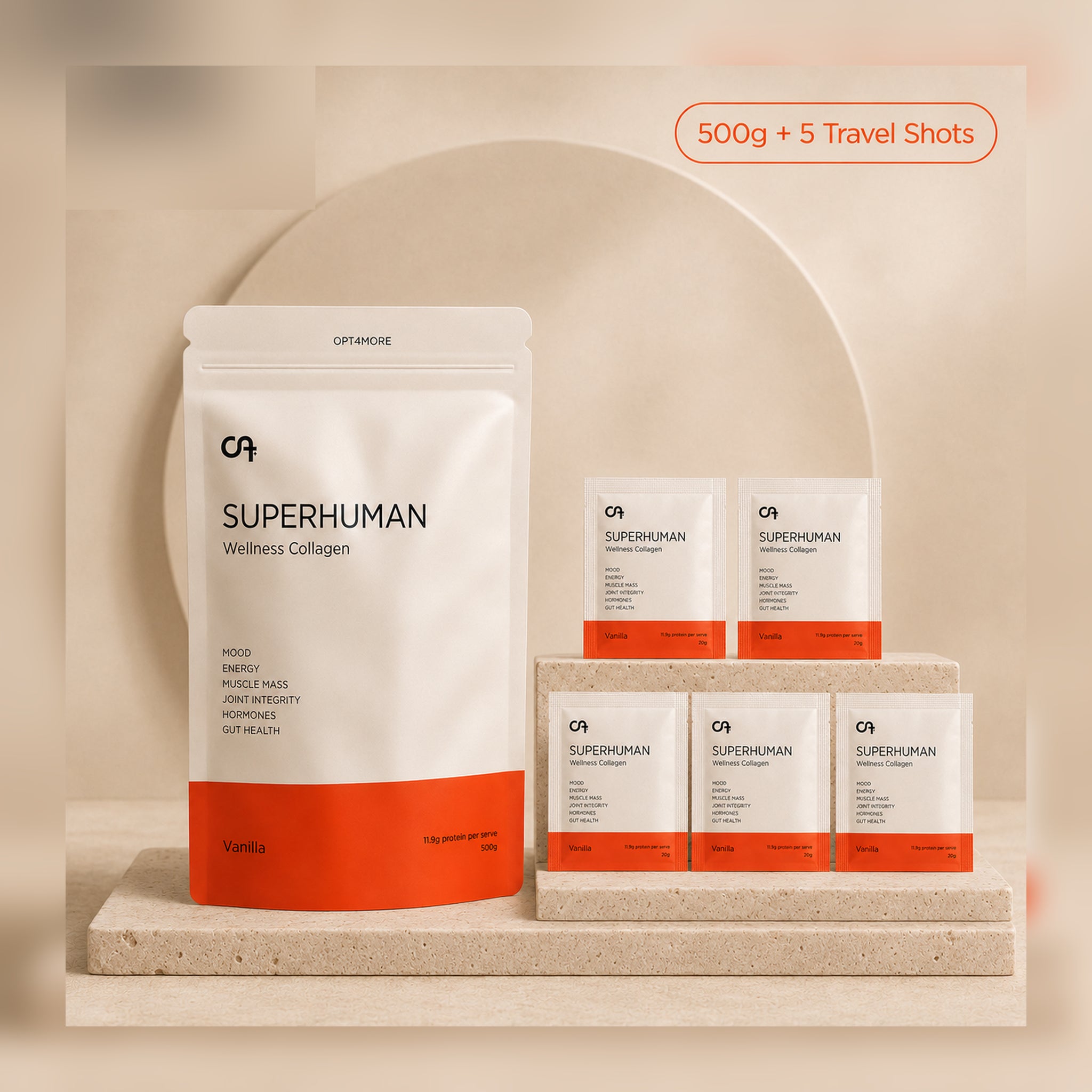
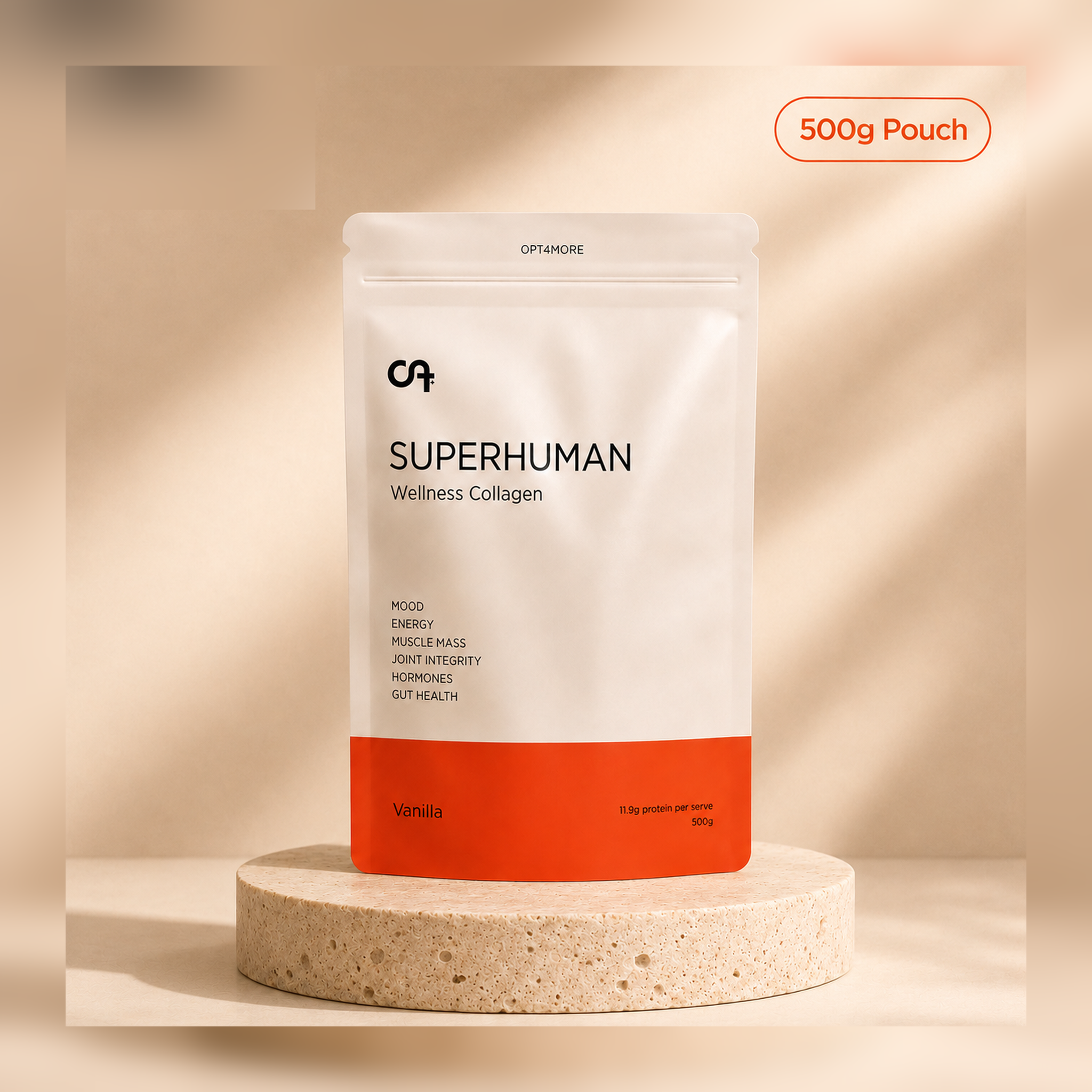
Joint comfort rarely improves through one heroic purchase. It comes from a routine that survives busy weeks, which is exactly what a single daily scoop is built for. Opt4SUPERHUMAN combines 12,895 mg of hydrolysed bovine collagen peptides with a named probiotic strain, prebiotic fibre, magnesium, calcium, zinc and vitamin D3 in one Australian-made blend. Get started with Opt4SUPERHUMAN and make your daily wellness ritual simple enough to keep.
Frequently Asked Questions
What are the benefits of collagen peptides for joints?
Research points to five main benefits: reduced joint pain, improved joint function and mobility, support for cartilage and connective tissue, faster recovery after strenuous exercise, and support for bone and muscle. A 2021 systematic review found all five included studies reported benefits for joint pain, function or pain-free exertion. These findings are promising but do not guarantee the same result for every product or person.
How long does collagen take to work for joints?
Give any collagen peptides routine several weeks of consistent daily use before judging results. Keep a simple note of how your joints feel each week so you can judge progress on your own experience rather than expecting an overnight change.
What is the right collagen peptides dosage for joints?
What matters is choosing a product that discloses its collagen amount per serve so you know what you are taking. The Superhuman Wellness Collagen Blend provides 12,895 mg of hydrolysed bovine collagen peptides per 20 g serve, alongside protein and other wellness ingredients, which makes the daily amount clear on the label.
Which type of collagen is best for joints?
Hydrolysed peptides are broken into smaller pieces, which is why they are used in supplements rather than whole collagen. When comparing products, check that the label names the collagen type and the amount per serve rather than hiding it behind a proprietary blend.
