

Last Updated: November 17, 2026
Quick Summary
The five best collagen types for skin and joints are Type I, Type II, Type III, Type IV and Type V. Type I supports skin firmness and hydration, Type II is the dominant collagen in cartilage for joint comfort and mobility, and Type III works alongside Type I for elasticity.
- Type I collagen is mainly associated with marine collagen, while Type II links primarily to chicken and bovine sources.
- Bovine collagen typically supplies Type I and Type III together, which is why many daily blends use a bovine base.
- Type IV collagen is the main protein of the basement membrane and appears only in small amounts in supplements.
- Check the collagen peptide amount per serve, not the total scoop weight, and look for hydrolysed peptides.
- The Superhuman formula provides 12,895 mg of hydrolysed bovine collagen peptides per 20 g serve.
Table of Contents
- The 5 Best Collagen Types for Skin and Joints at a Glance
- Type I Collagen for Skin: Structure, Firmness and Hydration
- Type II Collagen for Joints: Cartilage and Everyday Mobility
- Type III Collagen: The Elastic Partner to Type I
- Type IV and Type V Collagen: The Supporting Cast
- Marine vs Bovine Collagen: Which Source Suits Your Goals?
- How to Choose a Collagen Supplement: A Practical Checklist
- Dose, Duration and What Realistic Results Look Like
- Build Your Daily Collagen Routine with Superhuman
- Frequently Asked Questions
The 5 Best Collagen Types for Skin and Joints at a Glance
Not all collagen is built for the same job. The five most relevant collagen types for skin and joints are Type I, Type II, Type III, Type IV and Type V, and each one sits in a different part of the body doing a different task. This guide from Opt4SUPERHUMAN breaks down what each type does, where it comes from, and how to choose a supplement that actually matches your goal.
Collagen is the body's most abundant structural protein, forming the scaffolding that holds skin, bone, cartilage and connective tissue together. A review of clinical studies on collagen treatment notes that different collagen types come from different sources, with Type I mainly associated with marine collagen and Type II with chicken and bovine sources.
Here is the short version before the detail:
| Collagen Type | Main Location | Best Known For | Typical Source |
|---|---|---|---|
| Type I | Skin, bone, tendons | Firmness and hydration | Bovine, marine |
| Type II | Cartilage | Joint comfort and mobility | Chicken, bovine |
| Type III | Skin, blood vessels | Elasticity with Type I | Bovine |
| Type IV | Basement membranes | Tissue support layers | Bovine |
| Type V | Cornea, placenta, cell surfaces | Structural regulation | Bovine |
What most guides miss is that a supplement's label rarely tells you which type you are buying. Below, we explain exactly how to read it.
Type I Collagen for Skin: Structure, Firmness and Hydration
Type I collagen is the most abundant collagen in the human body and the primary structural protein in skin, bone and tendon. It gives skin its firmness and helps hold moisture within the dermal layer.
If skin is your main concern, Type I is the type to prioritise. It makes up the dense fibre network that keeps skin looking plump and resilient. Marine and bovine sources both supply it, though the two are processed differently.
The clinical review of collagen treatment describes Type I as mainly found in marine collagen, which is one reason marine products dominate the beauty shelf. Bovine collagen also delivers Type I, usually alongside Type III.
Best for: people focused on skin firmness, hydration and everyday connective tissue support. Skip if: your main goal is cartilage and joint comfort, where Type II plays a bigger role.
Type II Collagen for Joints: Cartilage and Everyday Mobility
Type II collagen is the dominant collagen in cartilage, the cushioning tissue between joints. It is the type most closely tied to joint comfort and everyday mobility.
Cartilage has no blood supply of its own, which makes it slow to repair. That is why Type II gets so much attention in joint-focused supplements. The same review of collagen studies links Type II primarily to chicken and bovine collagen sources.
Anyone with ongoing joint pain should speak with a health care professional rather than self-treating.
Best for: active people and anyone prioritising cartilage and mobility support. Skip if: skin firmness is your only goal.
Type III Collagen: The Elastic Partner to Type I
Type III collagen works alongside Type I in skin, blood vessels and internal organs, contributing to elasticity and tissue flexibility. It is rarely found alone in supplements because it naturally occurs with Type I in bovine sources.
Think of Type III as the flexible fibre woven through the stronger Type I framework. It supports the stretch and rebound that skin needs, particularly around areas that move constantly.
Bovine collagen typically supplies both types together, which is one practical reason many daily blends use a bovine base rather than a single isolated type.
Best for: readers who want elasticity support alongside firmness. Skip if: you are specifically targeting cartilage.
Type IV and Type V Collagen: The Supporting Cast
Type IV and Type V collagen are the two types most guides skip, yet they are the reason a multi-source or whole-food collagen base looks different from an isolated single-type product. Neither is a headline ingredient, but each has a distinct structural job.
Type IV collagen is the main protein of the basement membrane, the thin sheet that sits between the epidermis and the dermis and anchors skin cells to the tissue beneath. It also lines the basement membranes of blood vessels and internal organs. Think of it as the foundation layer rather than the bricks: it does not provide bulk, but it helps organise where cells sit and how they communicate with the tissue around them. In supplement terms, Type IV is usually present only in small amounts, and it is not the type most human skin or joint trials have focused on.
Best for: readers wanting a broad, naturally sourced collagen profile who understand that Type IV and Type V are present in small amounts. Skip if: you need a targeted single-type product with a disclosed amount of a specific type.
Marine vs Bovine Collagen: Which Source Suits Your Goals?
Marine collagen comes from fish and is predominantly Type I. Bovine collagen comes from cattle and typically supplies Type I and Type III together. The right choice depends on whether skin or joint support is your priority.
Marine collagen is popular for skin-focused routines because of its Type I concentration. Bovine collagen offers a broader spread of skin-relevant types and is the base used in many daily wellness blends, including the Superhuman formula. (Source: Weizmannia coagulans MTCC 5856)
Hydrolysed collagen peptides are broken into smaller fragments, which is why the peptide form is worth checking on the label.
Watch out: some marine products list a headline collagen figure that includes flavour or filler weight. Check the actual peptide amount per serve, not the total scoop weight.

How to Choose a Collagen Supplement: A Practical Checklist
Choosing well comes down to reading the label properly. Most collagen products look identical on the front of the pack, so the decision has to be made on the back.
- Check the collagen peptide amount per serve, not the total scoop weight
- Confirm which collagen types the source supplies
- Look for hydrolysed peptides, which are easier to absorb
- Check whether the label discloses amounts for every active ingredient
- Confirm the source suits your dietary and ethical preferences
- Check for allergens, particularly fish in marine products
- Compare price per serve rather than price per pack
- Look for third-party testing or clear quality statements
For a deeper, women-focused breakdown of label reading, see 7 things to check when choosing a collagen supplement for women.
Dose, Duration and What Realistic Results Look Like
Most collagen guides tell you to take it daily and wait. That is true but unhelpful. The more useful question is: what doses and durations have actually been studied, and what does that mean for your expectations?
Studied doses. The Superhuman formula provides 12,895 mg (about 12.9 g) of hydrolysed bovine collagen peptides per 20 g serve. Dose comparisons against published research depend on the study, population and outcome measured, so the product's amount should not be read as a guarantee of results.
Studied durations. Judging a collagen supplement over a consistent period, rather than after a few days, gives a fairer picture of what it may do for you.
Skin versus joints. Skin and joint goals may not move on the same timeline, and individual responses vary. None of this is guaranteed.
What the evidence does and does not show. It does not show that a particular type, source or product will produce those outcomes for every person, and collagen does not replace a balanced diet or treat joint disease. Anyone with ongoing joint pain or a diagnosed condition should speak with a health care professional rather than self-treating.
Consistency beats intensity. A daily serve taken at the same time each day is more useful than an occasional larger dose. Consistent daily intake is generally more useful than occasional larger doses. If you are weighing up whether daily collagen is worth it, this collagen powder daily review walks through the evidence honestly.
Watch out: some products list a headline collagen figure that includes flavour, filler or other ingredients. Check the actual hydrolysed peptide amount per serve, not the total scoop weight, and compare that figure against the studied ranges above rather than against the front-of-pack number.
Watch out: collagen is a protein, not a replacement for a balanced diet. It should sit alongside your overall nutrition, not replace it, and it is not a substitute for medical care.
Build Your Daily Collagen Routine with Superhuman
The simplest routine is the one you actually keep. The Superhuman Wellness Collagen Blend is an all-in-one daily collagen and wellness blend providing 12,895 mg of hydrolysed bovine collagen peptides per 20 g serve, plus 11.9 g of protein.
Beyond collagen, the formula brings together ingredients that play different roles. Weizmannia coagulans MTCC 5856 supplies 3 billion CFU of a named probiotic strain, while green banana resistant starch adds 2,000 mg. Green tea extract provides 400 mg standardised to 50% L-theanine, delivering 200 mg of L-theanine, and quinoa-sprout B-complex adds 200 mg. Digestive enzymes, Siberian ginseng, milk thistle, magnesium, calcium, zinc, iron and vitamin D3 round out the blend. Individual amounts for those last ingredients are not disclosed on the dose information available.
That breadth is the point. An approximate upfront checkout comparison of separate products across those categories runs to about $290, compared with $79 for one 500 g pouch, or $72 on subscription. Separate packs vary in size and serving duration, so this is not a dose-for-dose match.
One 500 g pouch gives 25 serves. Mix a scoop into water, a smoothie or coffee. If you want to know whether single-serve sachets suit your routine better than a tub, read are collagen sachets worth it. For fitting supplements into busy mornings, this simple daily supplement routine guide is a practical starting point. Ready to start? View the Superhuman Wellness Collagen Blend 500 g pouch.
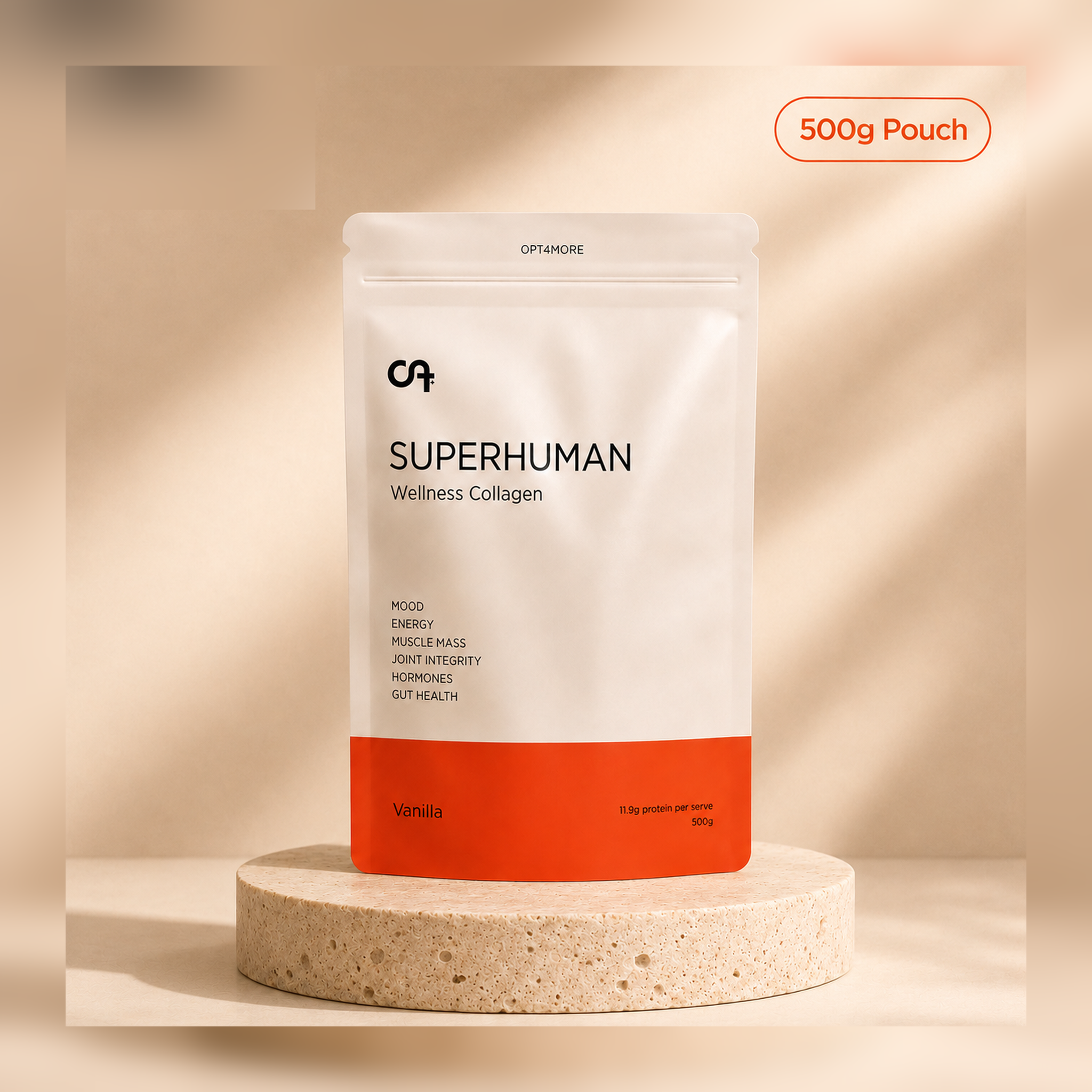
Building a collagen routine that lasts means choosing a formula broad enough to support skin, joints and everyday wellbeing in one daily habit, rather than juggling five separate products. Opt4SUPERHUMAN makes that simpler with a single scoop that combines hydrolysed bovine collagen peptides, the named probiotic strain Weizmannia coagulans MTCC 5856, prebiotic green banana resistant starch and a full supporting nutrient panel. Get started with Opt4SUPERHUMAN and build one daily ritual that covers more than collagen alone.
Frequently Asked Questions
Which type of collagen is best for skin?
Type I collagen is the main structural protein in skin. Type III collagen also plays a role in skin flexibility. Hydrolysed collagen peptides, which are broken into smaller pieces for easier mixing and absorption, are the form used in most supplement research. Results vary between people, and a supplement works best alongside a consistent daily routine rather than as a quick fix.
Which type of collagen is best for joints?
Type II collagen is the main collagen in cartilage, the tissue that cushions joints, so it is the type most associated with joint support and mobility. Some people also look for Type I because it is found in bone, tendons and ligaments.
What is the difference between Type I, Type II and Type III collagen?
Type I collagen forms the structural framework of skin, bone, tendons and ligaments. Type II collagen is found mainly in cartilage and supports joint cushioning. Type III collagen sits alongside Type I in skin and connective tissue and contributes to elasticity.
Is marine or bovine collagen better for skin and joints?
Marine collagen is mostly Type I, which makes it a popular choice for skin-focused routines. Bovine collagen provides mainly Type I and Type III, so it covers skin and connective tissue as well as bone and tendon structure. Neither is universally better; the right choice depends on your goals, dietary preferences and any allergies. Check the label for the collagen source and the disclosed amount per serve.
How long does it take to notice results from collagen supplements?
Judge a supplement over a consistent period rather than a few days. Take it daily at the same time, such as in your morning coffee or smoothie, and note how your skin and joints feel over time. If you have a medical condition, are pregnant or take regular medication, speak with a health care professional before starting a new supplement.
